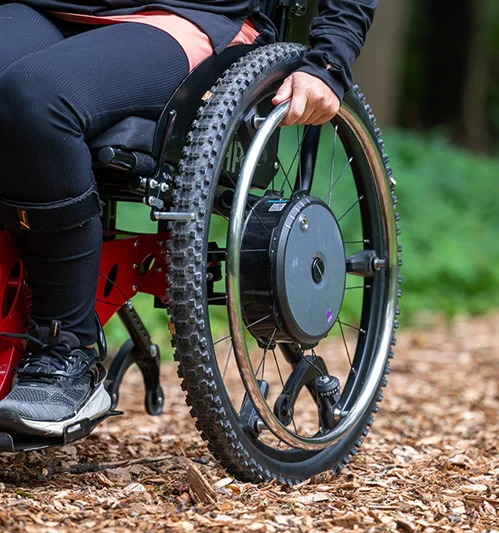

A wheelchair built for the beach gets stuck in the forest. One made for rocky trails is often too heavy to load into a trunk on your own. There’s no “universal” all-terrain wheelchair: there’s the right wheelchair for your terrain, your use and how often you head out. This guide helps you choose an all-terrain wheelchair by starting from the real question, the one people often forget to ask before looking at models: where do you want to go, and how?
We’ll work through it like a decision tree. First the need, then the technical criteria that truly matter, then which TrackZ model fits which kind of terrain.
Define your need before choosing: use, terrain, frequency
Before comparing wheels and suspensions, answer three questions. On their own, they rule out half the models.
- What’s the main terrain? Beach sand, forest trails, snowy ground, or mixed everyday surfaces (grass, gravel, broken-up sidewalks)? Sand and snow demand flotation. The forest demands ground clearance and ruggedness. Everyday use demands maneuverability.
- Manual, assisted or powered? Do you propel yourself, does a companion push, or do you want electric range over long distances and slopes? This choice depends on your strength, whether you have a helper, and how difficult the terrain is.
- How often, and transported how? An occasional family outing doesn’t have the same constraints as near-daily use. And if you have to load the wheelchair into a vehicle by yourself, weight and folding become decisive.
Remember this simple principle: the softer the terrain (sand, snow), the more you want flotation and wheel width; the rougher the terrain (roots, rocks), the more you want stability and suspension. These two demands aren’t met the same way, and that’s exactly what sets the models apart.
The technical criteria that make the difference
Three families of criteria really weigh on the decision. The rest is added comfort.
Wheels, tires and 3- or 4-wheel configuration
This is the number one criterion, and the “3 wheels or 4 wheels” question comes up in nearly every decision.
The 3-wheel configuration works like a tripod. One wheel at the front, two at the back: the frame stays in stable contact on uneven ground, because a tripod doesn’t tip when the terrain is bumpy. The result is excellent maneuverability for turning on narrow trails and reassuring stability on slopes. That’s the principle behind the HP Plus.
The 4-wheel configuration bets on flotation and obstacle clearance. Four points of support spread the weight better and help absorb roots, low steps and off-camber sections, especially when the frame has suspension. That’s the principle behind the HP4, with its knobby rear wheels and smaller front wheels designed to get over obstacles.
On the tire side, the logic is constant: wide, knobby tires for grip on soft ground, low-pressure inflated tires to float on sand or snow. A narrow, hard tire, even on a good frame, will sink in the sand.
| Configuration | Main strength | Best terrain |
|---|---|---|
| 3 wheels (tripod type) | Stability on uneven ground, maneuverability | Narrow trails, slopes, mixed terrain |
| 4 wheels | Flotation, obstacle clearance | Rough forest, roots, off-camber |
| Powered 4-wheel drive | Range, power over long distances | Demanding off-trail, long outings |
Weight, transport and folding
A wheelchair you can’t load on your own is a wheelchair that stays in the garage. Ask yourself honestly: who’s going to lift or fold the chair, and into what vehicle?
- More compact manual model: easier to transport, ideal if you alternate between daily use and short getaways.
- Rugged all-terrain model: heavier, often meant to be transported with the help of a companion or a ramp.
- Powered model: the most independent on the ground, but the most demanding in terms of transport and charging logistics.
Don’t sacrifice the flotation your terrain needs just to save weight. But if your outings are mostly urban and occasionally off-trail, a lighter model will serve you better than a heavy all-terrain chair that’s underused.
Manual, assisted or powered
The propulsion mode follows directly from your strength, whether you have a helper, and the elevation you face.
- Manual: you or a companion provide the effort. Excellent control, no battery constraint, but demanding on sand, snow and long climbs.
- Assisted: electric help is added to propulsion. A good compromise when the terrain becomes difficult here and there.
- Powered: full independence, clearing slopes and long distances effortlessly. It’s the way to go for demanding off-trail use, at the cost of heavier transport and maintenance.
Still hesitating between the main families? The article on the benefits of all-terrain wheelchairs sheds light on the “why” before the “how,” with user stories.
Once your profile is clear, you can compare the right models directly in the TrackZ all-terrain wheelchair lineup.
Which TrackZ model for which terrain
Here’s the concrete mapping. Each terrain has its dominant constraints, and each model answers a specific logic.
| Terrain / use | Dominant constraint | TrackZ model to look at first |
|---|---|---|
| Trails, forest | Stability, maneuverability, clearance | HP Plus (3 wheels) or HP4 (4 wheels) |
| Beach, sand | Flotation, wide tires | HP Plus, designed for beaches and slopes |
| Snow, winter | Grip, flotation | HP Plus / HP4 depending on the propulsion you want |
| Demanding off-trail, long distances | Range, power | Zoom (electric 4-wheel drive) |
| Mixed everyday use | Versatility, practicality | TJ Plus |
Trails and forest
In the forest, the enemies are roots, rocks and slopes. You want stability and ground clearance. The HP Plus and its 3-wheel configuration shine here with maneuverability through narrow passages and tripod-type stability on bumpy ground. If your terrain is rougher, with marked obstacles to clear, the HP4 and its four wheels with rear suspension absorb impacts better.
Beach and sand
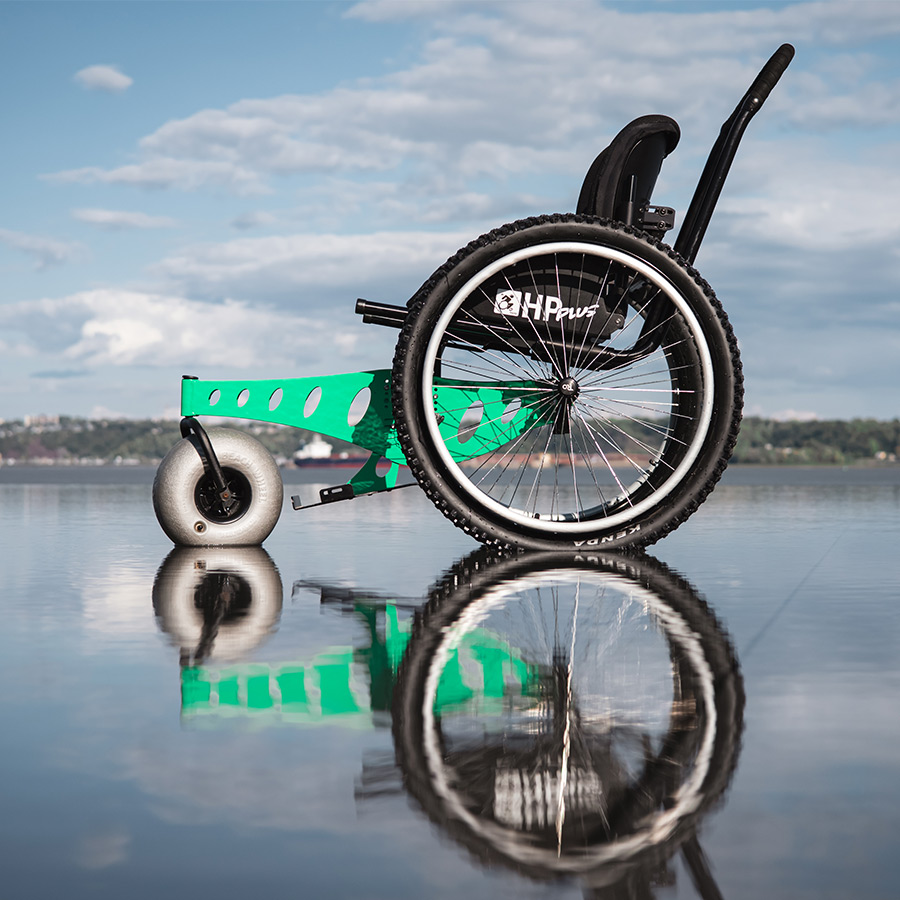
Sand doesn’t forgive narrow tires. Here, it’s all about flotation: staying on the surface rather than sinking. The HP Plus is explicitly designed for beaches and slopes, which makes it a logical starting point for seaside or lakeside use. The rule: favour wide wheels and a pressure suited to soft terrain.
Snow and winter
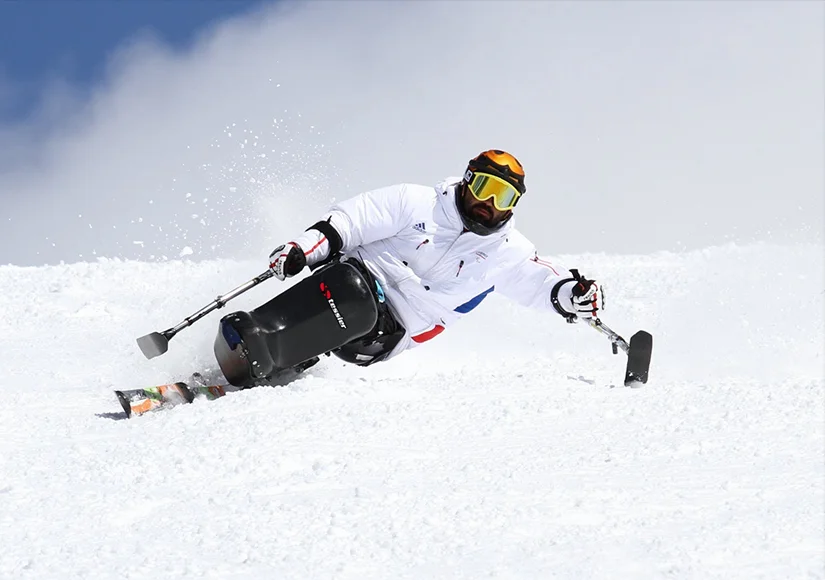
Snow combines two challenges: flotation (not sinking) and grip (not slipping). An all-terrain wheelchair with knobby wheels, well distributed on the ground, keeps grip where a standard wheelchair spins out. Depending on whether you want to propel yourself or get some help, the HP Plus or the HP4 cover winter outings. For long distances on packed snow or difficult terrain, the Zoom’s motor takes over.
Everyday use and transport (compact)
Not all uses are extreme. If your travels mix sidewalks, grass, gravel and short nature outings, the TJ Plus is designed for that versatile everyday use, on flat as well as slightly uneven ground. It’s the “Monday-to-Sunday” model rather than the expedition one. The Zoom, by contrast, is an electric 4×4 vehicle: it’s the choice for powered adventure, not urban practicality.
Budget and financing
An all-terrain wheelchair is an investment, and many people give up before even looking into what’s available. That’s a mistake. Several funding sources exist depending on your situation: public programs like RAMQ in Quebec, SAAQ or CNESST compensation, and private insurance.
The TrackZ A Little Push program isn’t direct financial aid, but free support: it helps you identify the funding sources you’re entitled to and, if needed, set up a crowdfunding campaign. In other words, we help you leave no money on the table.
Before giving up over a budget question, explore your financial support options through A Little Push.
FAQ
3 wheels or 4 wheels for all-terrain?
Three wheels offer tripod-type stability and better maneuverability on narrow trails and slopes. Four wheels offer more flotation and clear obstacles like roots and off-camber sections better. Choose 3 wheels for maneuverability, 4 wheels for very rough terrain.
Which wheelchair for the beach?
On sand, flotation comes first: you need wide tires that stay on the surface rather than sink. The HP Plus is designed for beaches and slopes, which makes it a relevant choice for seaside or lakeside use.
Can an all-terrain wheelchair be transported easily?
It depends on the model. A compact manual wheelchair like the TJ Plus is easier to transport, often with a companion. Rugged all-terrain and powered models are heavier and require suitable loading logistics (ramp, appropriate vehicle).
Which all-terrain wheelchair for snow?
Look for grip and flotation: well-distributed knobby wheels keep grip where a standard wheelchair spins out. The HP Plus or the HP4 suit manual or assisted winter outings; the powered Zoom takes over for long distances on difficult terrain.
Manual or powered: which to choose?
Manual suits you if you or a companion can provide the effort and the terrain stays moderate. Powered is a must for slopes, long distances and demanding off-trail use, in exchange for heavier transport and maintenance.
Find the wheelchair suited to your outings
The right wheelchair is the one that matches your terrain, your strength and your transport habits, not the most impressive one on paper. You now know the decision logic: start from your use, check the wheel configuration and the propulsion mode, then compare the models that tick your boxes.
Review the models and their configurations in the TrackZ all-terrain wheelchair lineup to find the one that will take you where you want to go.