An all-terrain wheelchair is a serious investment. For many people, it’s the only thing standing between them and getting back on a trail, onto the sand, or into the backyard with their kids. The good news: the sticker price is almost never what you actually pay in the end. Financing a wheelchair in Quebec relies on several sources of assistance that combine, and it’s precisely by stacking them that a project becomes realistic.
Here’s how the framework really works: what RAMQ covers, the other financial aid available, and how to build a solid application without getting lost in the paperwork.
What RAMQ covers (and doesn’t) for an all-terrain wheelchair
RAMQ funds wheelchairs in Quebec, but within a specific framework. Reimbursement goes through the Technical Aids Program, managed by public rehabilitation centres. A standard manual or powered wheelchair, deemed necessary for daily mobility, can be provided at no cost to an eligible person.
The key word is “standard.” A wheelchair designed for everyday indoor use and urban surfaces falls within the covered basket. An all-terrain wheelchair meets a different need, and that’s where the nuance matters.
RAMQ covers wheelchairs in Quebec through its Technical Aids Program, based on an evaluation by an occupational therapist or physiotherapist in a public rehabilitation centre. An eligible standard wheelchair can be provided free of charge. An all-terrain wheelchair generally falls outside the covered basket and requires other sources of funding.
The process through rehabilitation centres
A RAMQ-covered wheelchair isn’t requested directly from the Régie. It goes through a clinical evaluation. Here are the main steps:
- You are referred to, or you contact, the technical aids service of a public rehabilitation centre (often through your CIUSSS or CISSS).
- An occupational therapist or physiotherapist assesses your mobility needs, your remaining abilities and your living environment.
- The professional determines the type of wheelchair required and submits the request to the Technical Aids Program.
- If you are eligible and the recommended device is covered, it is provided to you.
Eligibility depends on your condition and a lasting need for mobility assistance, not on your income. It’s a clinical system: it’s the assessed need that decides, not the desire to obtain a particular model.
Why all-terrain often falls outside public coverage
The Technical Aids Program funds what is deemed necessary for basic mobility and daily independence. An all-terrain wheelchair goes further: it provides access to trails, the beach, the snow, terrain that even a standard powered wheelchair can’t handle. That need is real, but it generally doesn’t fall within the definition of the publicly covered basket.
In practical terms, this means a TrackZ wheelchair isn’t automatically reimbursed by RAMQ. That doesn’t close the door, though. Every situation is different, and depending on your file, part of your needs may fall under the public system while the all-terrain component is funded another way. That’s exactly what a personalized evaluation helps sort out.
Other sources of financial aid in Quebec
When the public system doesn’t cover the device, several levers exist. The key is rarely a single source: it’s the combination of two or three that makes the project possible.
SAAQ, CNESST and insurance
If your mobility need stems from a specific event, the organization responsible for compensation may fund the device, sometimes including needs beyond the RAMQ basket:
- SAAQ: if your condition results from a road accident, the Société de l’assurance automobile du Québec may cover mobility aids as part of your rehabilitation.
- CNESST: if your situation stems from a workplace accident or occupational illness, CNESST may fund the equipment related to regaining your independence.
- Private insurance: some group, disability or accident policies provide coverage for mobility aids. It’s worth checking your contract, even if you think you aren’t entitled.
In all three cases, the amount and eligibility depend on your file. There’s no universal answer: you need to have your situation assessed.
Tax credits, foundations and crowdfunding
These sources add to the previous ones and reduce the remaining balance:
- Tax credits: the disability tax credit and medical expense credits can lower the real cost of a mobility aid, both federally and provincially.
- Foundations and organizations: several Quebec foundations support the purchase of adapted equipment for people with disabilities. Criteria and available funds vary from one organization to another.
- Crowdfunding: a well-run campaign among your circle and community can cover a significant share of the funding. It’s often underestimated, yet it works when the approach is structured.
None of these paths requires you to be an expert. It mostly requires knowing which one to activate, in what order, and how to present a credible application.
Financing support at TrackZ
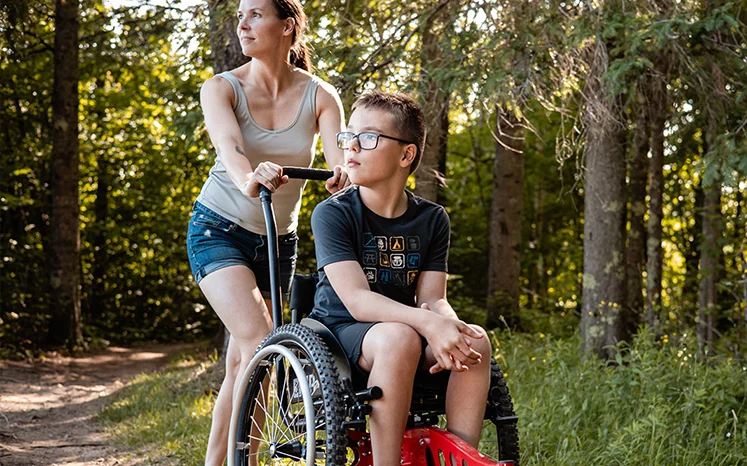
That’s exactly the role of the A Little Push program. Rather than leaving you to navigate RAMQ, SAAQ, foundations and tax credits on your own, the TrackZ team reviews your situation, identifies the sources you’re entitled to, and helps you build your application.
The program covers:
- Analysis of your possible government funding (RAMQ, SAAQ, CNESST, insurance).
- Personalized planning of the best combination for your needs.
- Full support for crowdfunding, from launching the campaign to ongoing help.
- An equal-instalment payment plan for the remaining balance.
Support is free and starts with a simple quote. You don’t need to know where to begin: that’s the team’s job. Discover the A Little Push program and see what you may be entitled to.
How to approach the budget for an all-terrain wheelchair
Before looking at the price, look at the use. An all-terrain wheelchair isn’t a comfort purchase: it’s a tool that restores access to places and activities. Framed that way, the budget is built backwards, starting from your real needs.
Three useful reflexes:
- Get the quote first. A specific amount anchors the process. It lets organizations and foundations assess a concrete request rather than an intention.
- Stack the sources. Partial public assistance, a tax credit, a foundation and a payment plan can, together, turn an intimidating amount into an achievable project.
- Don’t assume you’ll be refused. Many people give up before even submitting a file. An evaluation tells you exactly where you stand, with no commitment.
The budget for an all-terrain wheelchair can be planned. It’s not about paying everything at once, but about knowing which doors to open. You can explore the all-terrain wheelchair models to target the one that fits your lifestyle, then build the financing around it.
FAQ
Does RAMQ reimburse an all-terrain wheelchair?
RAMQ covers standard wheelchairs through its Technical Aids Program, based on an evaluation in a rehabilitation centre. An all-terrain wheelchair generally falls outside the publicly covered basket. It isn’t automatically reimbursed, but other sources of aid may fund it depending on your situation.
What financial aid exists for a wheelchair in Quebec?
Several sources combine: RAMQ (Technical Aids Program), SAAQ for road accidents, CNESST for workplace accidents, private insurance, the disability tax credit, foundations and crowdfunding. The best combination depends on your file.
How do I build a funding application for a wheelchair?
Start with an itemized quote. Have your eligibility for public sources assessed (RAMQ, SAAQ, CNESST), check your insurance and tax credits, then complete with foundations and crowdfunding. The TrackZ A Little Push program handles this process with you.
Does the TrackZ support program cost anything?
No. A Little Push support is free. It begins with a quote for your wheelchair, then the team analyzes your funding options and helps you structure your request, including a crowdfunding campaign if needed.
Do I need a low income to be eligible for RAMQ assistance?
Eligibility for the Technical Aids Program is based on your clinically assessed mobility need, not your income. It’s the occupational therapist or physiotherapist who determines the required device as part of your rehabilitation.
Let’s talk about your project
The price of an all-terrain wheelchair shouldn’t be what stops you. Between RAMQ, compensation organizations, tax credits, foundations and crowdfunding, there’s almost always a path. You just need to know which one to take in your case.
The TrackZ team does it with you, for free. Sign up for the A Little Push program, get your quote, and find out what aid you’re entitled to. A little push is sometimes all it takes.
